
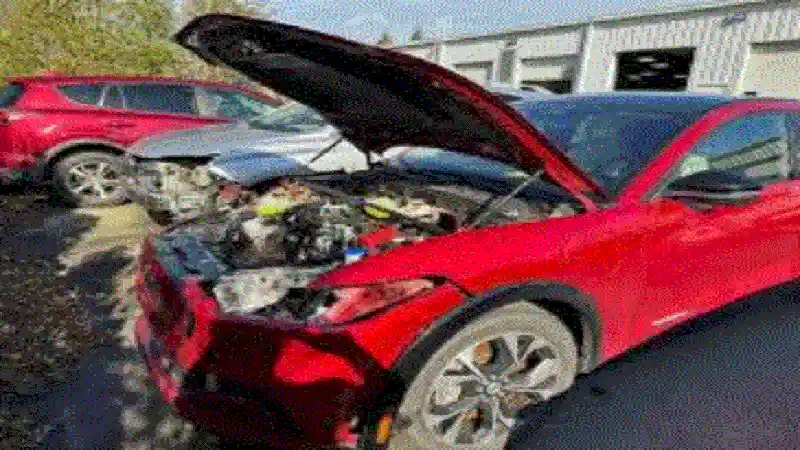
Imagine purchasing a state-of-the-art, $80,000 electric vehicle. It boasts a 400-mile range, hypercar-level acceleration, and a chassis so stiff it corners like a race car. Six months later, you slide on a wet road and bump a guardrail at 15 miles per hour. The cosmetic damage looks minimal—a cracked bumper and a dented quarter panel.
You take it to the body shop, expecting a routine repair bill. Instead, the mechanic calls you a week later with jarring news: the insurance company has declared the vehicle a total loss.
How does a highly engineered, modern marvel get sent to the scrapyard over a minor parking-lot-speed impact? The answer lies in the very materials that made the car so efficient in the first place. We have engineered vehicles to be incredibly light and fiercely strong, but in doing so, we have accidentally created the “unrepairable car.”
The Weight Penalty and the Rigid Solution
To understand this crisis, we have to look at the physics of the modern EV. Lithium-ion battery packs are exceptionally heavy, often weighing well over 1,000 pounds. If you put a heavy battery inside a traditional steel car frame, the vehicle becomes sluggish, handles poorly, and drains its own battery just moving its own bulk.
To offset this massive weight penalty, automotive engineers had to put the rest of the car on a radical diet. They shifted away from traditional, heavy steel and turned to advanced, lightweight structural materials. These materials offer an incredible strength-to-weight ratio, allowing a massive EV to feel nimble.
But this strength comes with a fundamental change in how the car behaves during a crash.
Bending vs. Shattering
For a century, collision repair has relied on the predictable nature of metal. Steel is ductile. When it sustains an impact, it bends, folds, and yields. This “crumple zone” absorbs the kinetic energy of the crash, protecting the passengers inside. Because metal bends, a skilled technician can often put the car on a frame machine, heat the metal, and pull it back into its original factory alignment.
Advanced lightweight structures do not bend. They are engineered to be incredibly rigid.
When an impact occurs, instead of folding like an accordion, the material absorbs energy by shattering, fracturing, or delaminating (where the microscopic internal layers of the material violently peel apart).
This shattering process is incredibly efficient at dissipating crash energy and keeping passengers safe. However, it is a one-way street. You cannot simply “pull” or weld a shattered structural tub back together. Once the microscopic fibers are broken, the structural integrity of that section is permanently gone.
The “Black Box” of Structural Diagnosis
The most terrifying part for an insurance adjuster isn’t just that the material shatters; it’s that the shattering is often invisible to the naked eye.
When a traditional steel frame is bent, you can clearly see the crease. When a rigid, advanced chassis takes a hit, the exterior surface might simply flex and snap back into place, looking completely pristine. However, deep inside the layers of the material, catastrophic micro-fractures may have formed.
As the adoption of automotive composites scales from hypercars to daily commuters, the collision repair industry is facing an unprecedented skills gap. The average neighborhood body shop does not possess the aerospace-grade ultrasonic or X-ray equipment required to perform Non-Destructive Testing (NDT) on these structures.
If the mechanic cannot definitively prove that the internal structure is flawless, they face a massive liability nightmare. If they patch the cosmetic damage, send the car back on the road, and the weakened chassis catastrophically fails in a subsequent crash, the shop is liable.
Faced with this “black box” of invisible damage and the high cost of specialized diagnosis, insurance companies simply crunch the numbers. It is mathematically cheaper and legally safer to write a check for the total value of the car than to risk an unverified repair.
The Modular Future
Automakers are keenly aware of this bottleneck. A system where 15-mph impacts lead to totaled vehicles is economically unsustainable and environmentally disastrous, as perfectly good batteries and electric motors end up sitting in salvage yards.
The solution currently being engineered is “modularity.” Instead of building the car around a single, massive, monolithic structural tub, designers are segmenting the chassis. They are utilizing advanced materials in bolt-on “crash cans” and sub-frames. When an impact occurs, the sacrificial, lightweight module shatters exactly as intended, but it can be cleanly unbolted from the main chassis and replaced with a factory-new part in a matter of hours.
Conclusion
We are in the awkward teenage years of automotive materials science. We have successfully figured out how to make cars incredibly light, stiff, and safe, but the infrastructure required to fix them after they do their job is lagging decades behind. Until repairability is engineered into the blueprint alongside aerodynamics and battery range, the true cost of driving the future might just be a fender bender away. See more: justalittlebite.co.uk